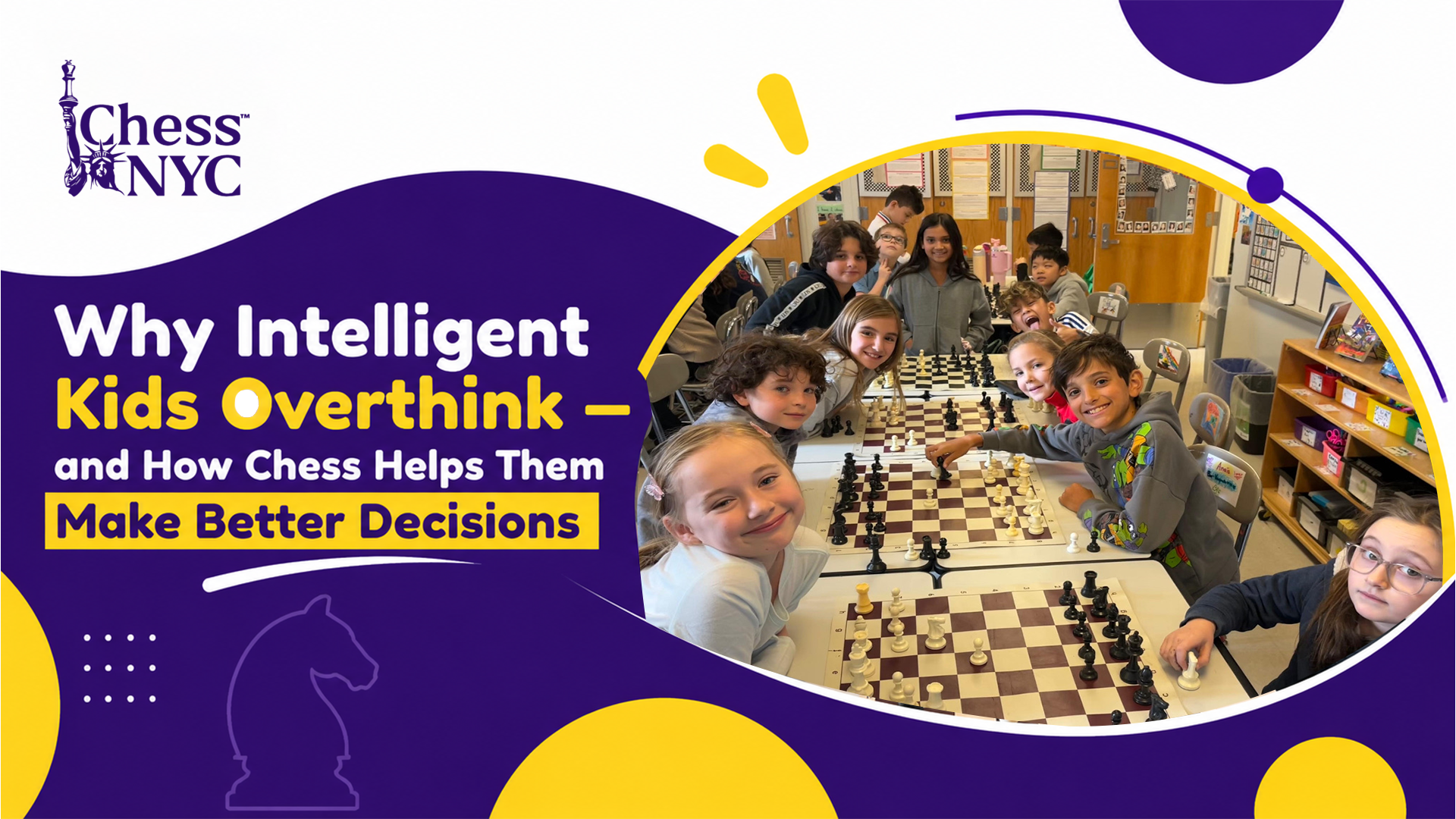
Chess has been called the "game of kings" for a reason. For over 1,500 years, it's been used to sharpen minds, test patience, and teach people — young and old — how to think several steps ahead before making a move. It's not just a board game; it's a quiet training ground for the brain. And it turns out, that training ground might be exactly what smart, thoughtful kids need most.
Here's something a lot of parents notice but rarely talk about: the smartest kid in the room is often the one who takes the longest to answer a simple question. Ask them what they want for dinner, and you'll get a five-minute pros-and-cons list. Ask them to pick a book at the library, and they'll still be standing there when it's time to leave. It's not indecision exactly — it's overthinking. And ironically, it tends to hit bright kids the hardest.
Why Smart Kids Overthink in the First Place
Intelligent children often see more possibilities than their peers. Where another kid sees two options, a sharp-minded child sees six — plus every possible outcome of each one. That's a gift in a lot of ways. But without a framework for narrowing things down, it becomes paralyzing. The brain gets stuck running simulations instead of committing to a choice.
This is where chess and decision making intersect in a surprisingly direct way. A chess board is, in essence, a controlled environment for practicing exactly the skill overthinkers struggle with: weighing options quickly, accepting imperfect information, and moving forward anyway.
How Chess Builds Real Decision-Making Skills for Kids
When a child sits down at a chessboard, they're immediately faced with a version of the same problem they face at the dinner table — too many choices, not enough certainty. The difference is that chess comes with a clock, a set of rules, and consequences that are immediate and visible.
A few ways this plays out on the board:
- Time pressure teaches decisiveness. With a clock running, a child can't spiral through every possible line forever. They learn to trust a "good enough" move over an endless hunt for the "perfect" one — a skill that translates directly into everyday life.
- Consequences are immediate, not abstract. Overthinking often comes from a fear of getting it wrong. Chess shows kids, move after move, that a wrong decision isn't catastrophic — it's information. You adjust and keep playing.
- Pattern recognition replaces panic. As kids play more, they stop analyzing every position from scratch and start recognizing familiar shapes and setups. This is the same mental shortcut adults use when making fast, confident decisions in daily life.
- They learn to commit, then adapt. Chess rewards players who make a reasonable plan and adjust it as new information comes in — not players who wait for total certainty before acting.
This is really strategic thinking skills in its most practical form: not overanalyzing every possible future, but making a solid call with the information you have right now.
Critical Thinking for Kids: More Than Just Puzzles
A lot of activities claim to build critical thinking for kids — puzzles, brain teasers, logic games. What sets chess apart is that it's not a solitary puzzle with one fixed answer. There's another mind on the other side of the board, actively working against you, changing the situation with every move. That unpredictability is exactly what makes it such an effective training tool for real-world thinking, where life rarely hands you a neat, single "correct" solution either.
At ChessNYC, we see this shift happen in kids all the time. A student who used to take three full minutes to decide on a simple recapture starts, after a few months of coaching, making confident choices within seconds — not because the position got easier, but because they've built the mental muscle to trust their own judgment. That's chess for problem solving in action: not eliminating uncertainty, but learning to act well within it.
From the Chessboard to Real Life
Parents often ask us how this actually transfers outside the 64 squares. The honest answer: kids don't consciously think "I'm using chess logic" when they're deciding which class to take or how to handle a disagreement with a friend. But the underlying habits — narrowing choices, tolerating some risk, trusting a decision once it's made — carry over quietly, over time.
This is one of the clearest ways to improve decision making in children without turning it into a lecture. Nobody enjoys being told to "just make a decision already." But nobody minds hearing "it's your move" from a chess coach — and the lesson sinks in anyway.
Coaches trained in thinking skills for children know how to nudge a young overthinker without shutting down their natural curiosity. It's a balance: encourage the deep thinking that makes these kids special, while building the confidence to act on it.
How ChessNYC Approaches This With Young Players
Since 2007, ChessNYC has worked with thousands of students across New York City — through after-school programs, camps, and private lessons — many of whom show exactly this pattern: bright, thoughtful, and a little too cautious when it's time to commit to a move. If you've been searching for a chess coach in NYC who understands this specific kind of learner, this is exactly the gap our coaches are trained to fill — recognizing overthinking early and guiding students toward faster, more confident decision-making, without rushing them past the thinking they're naturally good at.
Whether your child is just learning how the pieces move or is already competing in scholastic tournaments, ChessNYC offers a path built around their pace:
- After-school and fun training camps — our most popular chess camp option for kids who thrive in a group setting
- One-on-one private lessons, in-person or online, ideal if you're specifically looking for chess lessons near me with a more personalized pace
- Play N' Go online events for kids ready to test their decision-making under real tournament conditions
- Open enrollment programs for families looking to start anytime during the year
And it's not just kids — we regularly hear from parents searching for chess classes NYC adults, since these same decision-making benefits apply well beyond childhood. A parent who signs up alongside their child, or an adult beginner joining on their own, works through the exact same process of learning to trust a decision and move forward.
Research on chess and cognitive development — including studies referenced by organizations like the US Chess Federation — consistently points to gains in planning, patience, and problem-solving among young players. What we see day to day at ChessNYC lines up with that: kids don't just get better at chess, they get better at deciding.
Frequently Asked Questions
Does chess really help with decision-making skills, or is that just a myth?
It's backed by both research and what coaches observe firsthand. Chess forces kids to make choices under time pressure and live with the results, which builds the same mental muscles used in everyday decision-making — evaluating options, accepting some uncertainty, and committing to a choice.
My child is very smart but freezes up when making choices. Would chess help or make it worse?
Chess is actually well suited to this exact profile. A skilled coach won't push a child to rush — instead, they'll gradually build the child's confidence in their own judgment, using the game's structure and time limits as a gentle, low-pressure training ground.
What age should my child start chess to build these skills?
ChessNYC works with students from age 4 all the way through adulthood. Younger kids tend to absorb decision-making habits more intuitively, but it's genuinely never too late to start — we see meaningful growth at every age.
Do I need to know how to play chess to support my child's lessons?
Not at all. Our coaches handle all the instruction — your role is simply to encourage consistency and celebrate the small wins, like a faster decision or a move made with confidence instead of hesitation.
How is this different from just doing puzzles or brain games at home?
Puzzles usually have one fixed solution. Chess involves an opponent actively responding to your choices, which mirrors real-life decision-making far more closely — where situations shift and there's rarely one "correct" answer.
I searched for "chess tutor NYC" — is a private tutor better than a group class for a child who overthinks?
Both can work well, and it often comes down to the child. A private tutor can move at a highly individualized pace and give immediate, one-on-one feedback on decision-making, while group classes and camps add friendly social pressure that can also push overthinkers to commit faster. Many ChessNYC families actually combine both over time.
Give Your Child the Tools to Decide with Confidence
Overthinking isn't a flaw — it's often a sign of a genuinely thoughtful mind. The goal isn't to make your child think less, but to help them trust their thinking enough to act on it. Chess offers exactly that kind of practice, one move at a time.
Book a free evaluation with ChessNYC today and see how our coaches help kids turn careful thinking into confident decisions — on the board and off.