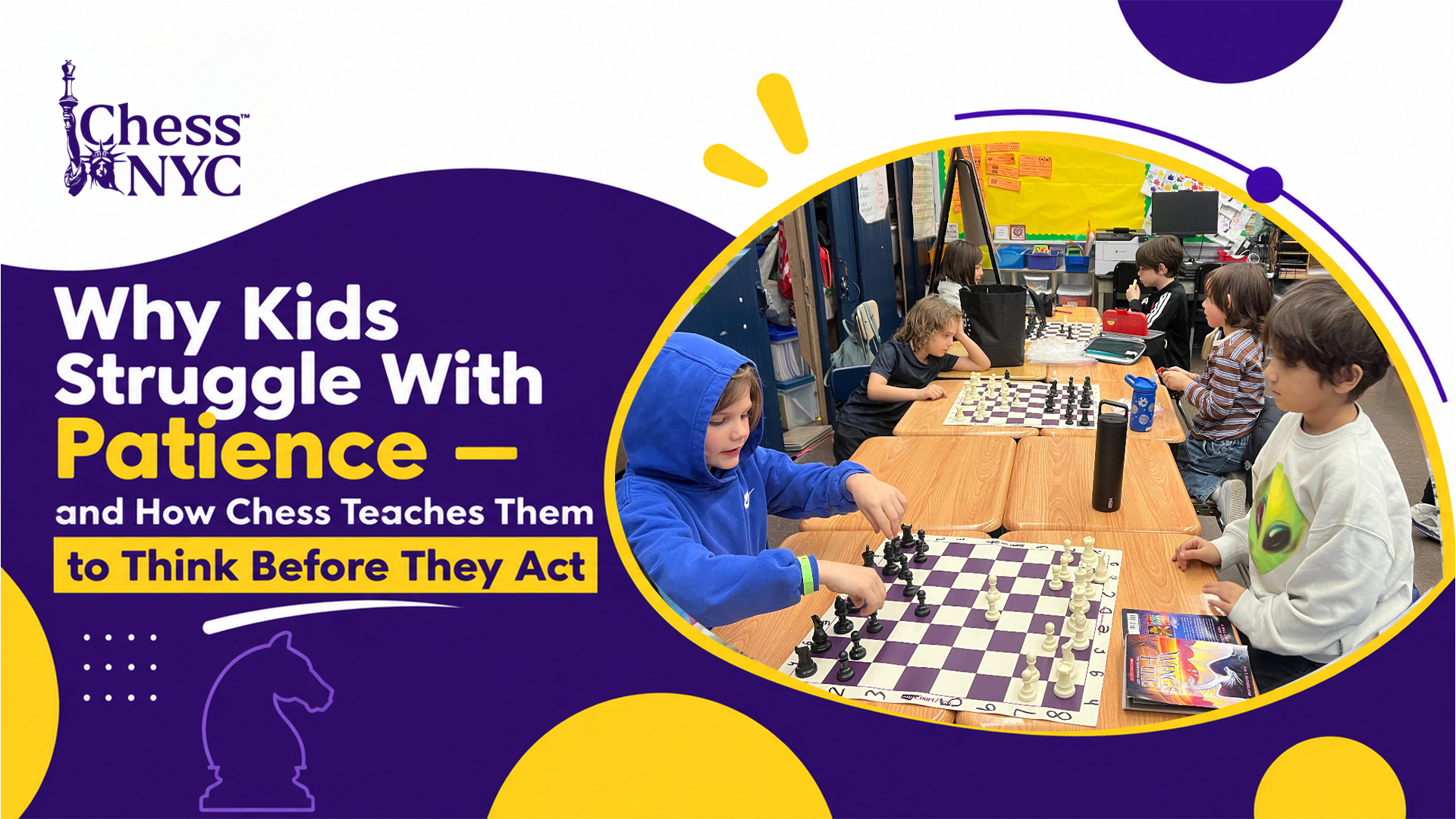
Watch any parent try to get a five-year-old to wait their turn, and you'll see the same scene play out everywhere — fidgeting, whining, sometimes a full meltdown over something as small as waiting two extra minutes. It's easy to label this as bad behavior. It isn't. It's biology doing exactly what it's supposed to do at that age. But there's a quiet, centuries-old activity that's been building patience skills for kids long before anyone had a name for "self-regulation" — chess.
This isn't about turning your child into a grandmaster. It's about understanding why patience is genuinely hard for kids, and why something as simple as sitting across a chessboard can teach them to think before they act in a way that lectures never quite manage.
Why Kids Struggle With Patience in the First Place
Before jumping into solutions, it helps to actually understand what's happening inside a child's head when they can't wait, can't sit still, or blurt out an answer without thinking.
The brain simply isn't built for patience yet. The prefrontal cortex — the part responsible for planning, impulse control, and thinking ahead — doesn't fully mature until a person's mid-20s. For young children, this region is still very much under construction. So when a child struggles to wait or pause before reacting, it's not defiance. It's a brain that hasn't finished building the tools for that job yet.
Instant gratification has become the norm. Apps, games, and videos are engineered to reward attention within seconds. A child taps, and something happens immediately. Over time, this trains the brain to expect quick outcomes, and anything that requires sitting with uncertainty — like waiting, or thinking through a problem — starts to feel unnatural, even uncomfortable.
There are fewer everyday chances to practice waiting. A generation ago, kids waited for things constantly — for a show to air, for a letter to arrive, for a turn on the swing. Today, deliveries are fast, answers are one search away, and entertainment is on-demand. Ironically, the fewer chances kids get to practice patience, the harder it becomes when they actually need it.
Emotional regulation is still forming. A lot of what looks like impatience is really frustration in disguise. When a child hasn't yet learned to manage that frustration, they act on it immediately instead of pausing — which is exactly the gap that teaching kids patience needs to close.
None of this means a child is broken or difficult. It means patience is a skill, not a personality trait, and skills need practice to develop. That's where chess quietly does more work than most people give it credit for.
How Chess Teaches Patience — One Move at a Time
Chess doesn't teach patience by talking about it. It teaches patience by putting a child in a situation where patience is the only way to actually win. That distinction matters more than it sounds.
Every move has a real consequence. There's no undo button in chess. A rushed decision can cost a piece, a position, sometimes the entire game. Kids figure this out fast — not because someone told them to slow down, but because they felt what happens when they don't. That direct cause-and-effect loop is one of the quickest ways to build patience, far faster than any verbal reminder.
It builds the habit of pausing before acting. Ask any strong chess player, young or old, and they'll tell you the same thing — good moves come from stopping, scanning the board, and weighing two or three options before committing. Do this enough times, across enough games, and that pause starts showing up outside the chessboard too. In homework. In arguments with a sibling. In moments where a child would normally react first and think later.
It rewards planning over impulse. Chess is fundamentally a game of thinking several steps ahead. A child playing seriously starts asking themselves, almost without realizing it, "what happens if I do this?" That single question, repeated across hundreds of games, is really the foundation of self-control for children.
Losing becomes a lesson instead of a meltdown. This might be the most underrated part. Chess introduces kids to losing in a structured, low-stakes way, over and over again. Instead of an emotional blowup, they start learning to sit with the disappointment, figure out what went wrong, and try again next game. That's real frustration tolerance being built, quietly, one loss at a time.
Long games train attention span. A single chess game can take a few minutes or well over an hour. Just sitting through it — engaged, thinking, not checking out — trains a child's ability to sustain focus. And sustained focus and patience are, more often than not, two sides of the same coin.
Chess Benefits for Children That Go Beyond the Board
The part that surprises a lot of parents isn't that chess teaches patience — it's how far that patience travels once it's learned. Teachers and parents who've watched kids stick with chess for a few months tend to notice the same shifts:
Better focus during homework, without needing to be reminded five times to sit back down. Fewer impulsive reactions when something doesn't go their way. A noticeably easier time waiting for turns or instructions, whether that's in a classroom or at the dinner table. And maybe most importantly, more comfort with problems that don't have an instant answer — because chess trains a child to sit with a hard position instead of giving up on it.
This is the real difference between chess and "teaching patience" as a concept. Chess doesn't explain patience to a child. It gives them dozens, sometimes hundreds, of small chances to practice it — and practice is what actually changes behavior.
Why Chess Works Where Lectures Don't
Every parent has tried the direct approach at some point — "just be patient," "think before you act," "slow down." And most of the time, it doesn't stick, not because the child isn't listening, but because patience isn't something you can explain a child into having. It has to be lived through, again and again, until it becomes automatic.
Chess creates exactly that kind of environment. Impulsive moves have consequences the child can see immediately. Thinking ahead gets rewarded, right there on the board. Mistakes aren't punished — they're simply part of the next game. And self-discipline builds gradually, through repetition, not through pressure or scolding.
This is also why many families in places like New York look for structured chess classes rather than just teaching the rules at home. A good coach or a consistent chess camp gives a child regular practice, a bit of friendly competition, and enough repetition for these patience-building moments to actually add up. Whether it's weekly chess lessons, a summer chess camp, or joining a local chess club, the structure itself does a lot of the heavy lifting — kids show up, play, lose sometimes, win sometimes, and slowly the pausing-before-acting habit becomes second nature.
For families exploring this seriously, working with an experienced chess coach or enrolling in organized chess classes can also open the door to rated tournaments down the line, which brings its own layer of patience-building — learning to sit through a long tournament game, manage nerves, and stay composed regardless of the result.
Frequently Asked Questions
At what age should a child start learning chess to build patience?
Most coaches suggest starting anywhere between ages 5 and 7, once a child can sit and focus for short stretches. That said, there's no strict cutoff — kids who start a little later, around 8 or 9, often pick up both the game and its patience-building benefits just as effectively, sometimes faster because they can grasp strategy more easily.
How long does it take before parents notice a change in patience?
This varies a lot by child, but many parents report noticing small shifts — like sitting through a task without giving up, or pausing before reacting — within two to three months of consistent play, whether that's casual games at home or structured chess classes once or twice a week.
Does my child need to be naturally good at chess for it to help with patience?
Not at all. In fact, kids who struggle initially often benefit the most, because every lost game is another rep in learning to sit with frustration and try again. The skill-building happens through the process of playing, not through winning.
Is playing chess casually at home enough, or does structured coaching matter?
Casual play at home is a great starting point, but structured settings — a coach, a class, or a chess camp — tend to accelerate things. Consistent practice, a bit of gentle competition, and exposure to different playing styles give a child far more repetitions than occasional games at the kitchen table.
Can chess help kids who already have an official diagnosis related to impulse control?
Many parents and educators do find chess helpful as a complementary activity for kids working on impulse control, since it offers a structured, low-pressure way to practice pausing and thinking. That said, chess isn't a replacement for professional guidance — it works best alongside any support a child is already receiving, not instead of it.
What's the difference between chess and other strategy games when it comes to teaching patience?
Many strategy games involve some forward thinking, but chess is unusual in how directly and immediately it punishes impulsive decisions — there's no dice roll or luck factor to soften a rushed move. That tight cause-and-effect connection is a big part of why chess, specifically, is so often recommended for building patience and self-control.
Final Thoughts
Kids aren't impatient because something is wrong with them. It's simply how a developing brain behaves in a world built for speed. But like any skill, patience can be practiced and strengthened over time — and chess happens to be one of the most effective, low-pressure ways to do exactly that.
It slows kids down. It teaches them to think before they act. And somewhere in between the wins, the losses, and the long pauses over the board, it quietly builds the very thing most parents wish came a little more naturally — patience, focus, and self-control.